


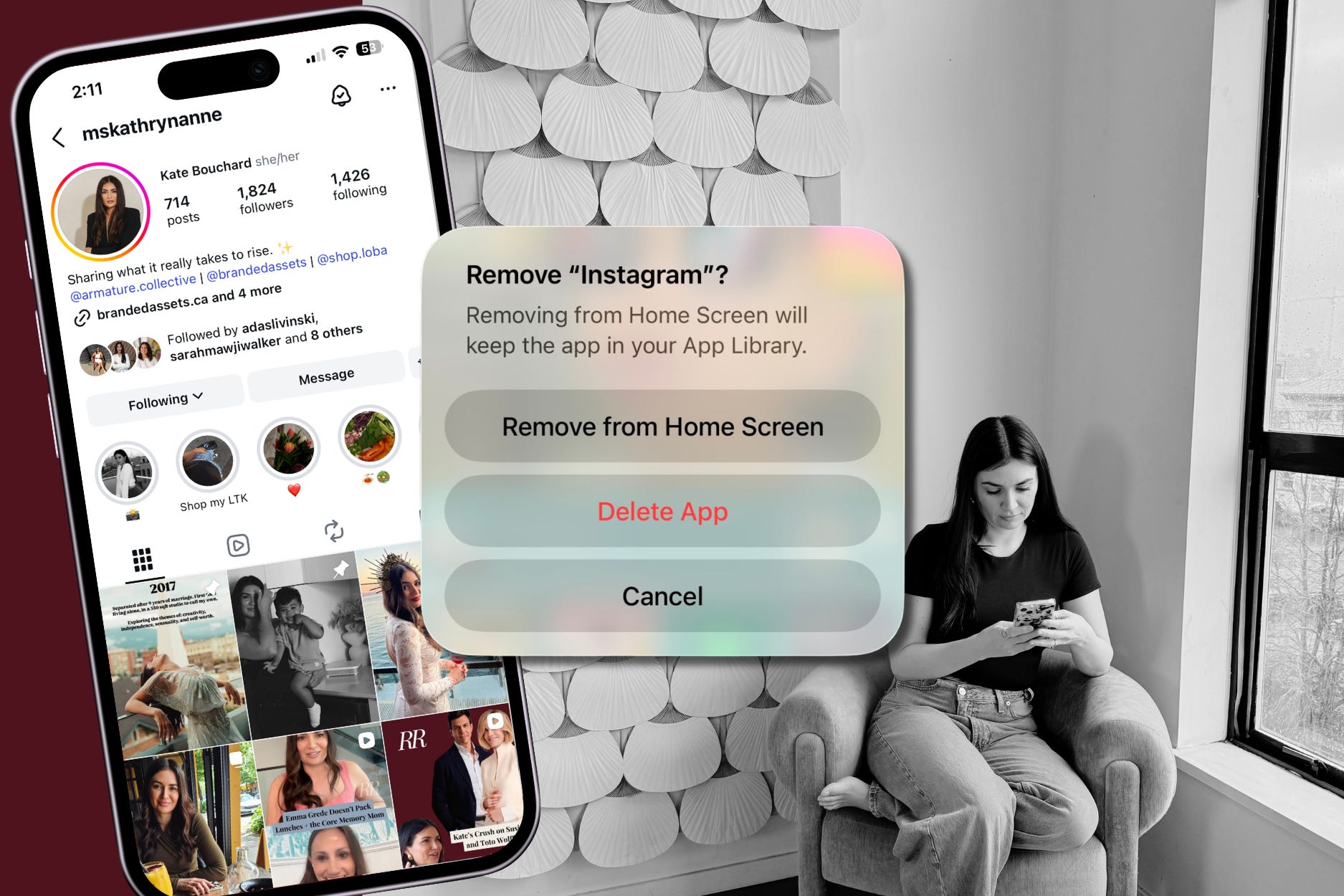
On a Thursday morning about a month ago, I deleted Instagram from my phone.
It was spontaneous. I didn’t put much thought into it in advance. My mom was visiting for a few days to help with our son, and I wanted to use that temporary gift of time wisely. I was tired of constantly picking up my phone and instinctively opening Instagram just because it had become a habit.
I’ve had Instagram notifications turned off for years. My phone doesn’t light up when someone likes a photo, comments on a post, or sends me a message.
Still, opening the app had somehow become a reflex.
When you own your own business, social media can be a powerful tool for getting in front of new audiences and reminding existing ones that you’re still here.
Or at least, that’s how it used to feel. Today, many entrepreneurs, including myself, find it frustrating.
I’ve flirted with leaving Instagram entirely but never gone all the way.
As a marketer whose team supports thought-leadership clients, there’s always a Reel that needs trending audio attached to it or a post that could use amplification. Social media is where people see your work, your perspective, the conferences you’re attending, the campaigns you’ve launched, the things you’re building, and what you care about.
For years, the equation seemed straightforward: You post. People engage. You build community. You grow an audience. Business opportunities follow.
Today, the equation feels different.
Over the last 4-5 years, I’ve watched engagement and discoverability steadily decline on Instagram. Not on my own account, but across the platform as a whole. Even when a video does rack up hundreds of thousands of views, it barely moves the needle on follower growth. Whenever I see an unknown creator’s post blow up, I click through to their profile to see what happened next. Often it’s very little.
Effort and outcome seem increasingly disconnected in the space. And yet, there’s no arguing that awareness is capital for entrepreneurs.
The founder who becomes synonymous with their industry. The creator who turns an audience into a business.
I’ve seen it firsthand in my own career. Clients have discovered Armature through social media. Speaking opportunities and networking invitations have landed in my inbox because someone happened to come across a post at the right moment.
On an early Branded Assets episode, I talked about a new brand called Sleep or Die, founded by Lauren Sudeyko. Her bold visual identity and sexy packaging caught my attention. I don’t know Lauren personally, but many people in my network do, and I’ve been fascinated to watch what happened next.
That post reached more than 200,000 people in just four days. A few months later, she’s moved to Los Angeles and has now raised more than $1 million from investors.
Awareness matters.
What I’ve started questioning isn’t the value of awareness. It’s the price of admission.
Instagram rewards constant presence. When I put time, energy, money, and effort into creating content, I see an uptick in views, impressions, and engagement. When I’m on the app constantly throughout my work day, liking, engaging, and commenting on others’ content, I can easily reach 40,000 or 50,000 views in the last 30 days. For an account with less than 2,000 followers, that’s a decent reach.
But how much of ourselves should we hand over to the algorithm before we decide the exchange rate isn’t worth it anymore?
After Mom returned home and the weekend came to a close, I wasn’t craving that hit. I stopped picking up my phone and mindlessly scrolling through. Something shifted in me. Instagram started to feel more like Facebook - an account I still technically have, but rarely look at and don’t feel compelled to stay long.
The problem? I truly still need it for work.
So, I decided to use my desktop internet browser to login to Instagram during specific and short periods during the work day. Reply to messages or comments. Get in, get out. Do it consciously and with intention. If I needed to post a Branded Assets clip to Stories or help with a client campaign, I’d download the app, do what I needed to and delete it again.
Now, I love a good meme. Relatable parenting moments. Anything that trolls the Trump administration with a sense of humour. (Readers, the Reflection Pool’s algae is back and the American Flag blue paint is already peeling. Can you believe it!?)
After the cortisol spike that comes with getting my kid to bed, sometimes I need a bit of scrolling to release the stress. I have missed that.
I’m not sure it’s social media I’m sick of. I’m sick of caring about it.
I’m sick of wondering whether the Reel I put an hour into creating is going to result in any measurable upside. Sick of feeling pressure to create content that will somehow break through. Sick of spending mental energy on metrics that often feel disconnected from actual business results.
Visibility is absolutely a business asset. But exposure is a personal liability.
As founders, we’re increasingly encouraged to build in public. Share your journey. Tell your story. Show your personality. Let people get to know you.
For women, that line becomes especially blurry.
I’ve found that male entrepreneurs often build authority around ideas. Female founders frequently seem expected to build authority around themselves.
Their face. Their family. Their personality. Their lifestyle. Their appearance.
The line between professional visibility and personal exposure gets blurry, fast. Having a public profile can get you exposure but it’s also exposing - opening you up to judgements, criticisms, malintent, and honestly, the occasional miserable person looking for someone else to blame their issues on.
I’ve spent years sharing small pieces of my life online. Some of those posts have led to opportunities. Many have created meaningful connections that I’m grateful for today. Some have reminded people that I exist when they need marketing support.
All of it comes with a cost. The emotional ROI just isn’t what it used to be.
I’m tired of the pressure to talk about myself, promote myself, and ask people to share my business, like a post, or buy a product. I’m tired of feeling like I need to translate my life into content for any other reason that I just feel like sharing.
I roll my eyes more than I’d like to admit at LinkedIn posts that start with ridiculous statements like “What my toddler taught me about B2B sales”, wellness influencers documenting their “hydration journey” as though they’ve discovered a revolutionary concept. (It’s water. You’re drinking water.), and performative authenticity (“I’m so excited about my new business I just had to pull over on the side of the road and post right away!”).
Sometimes I wonder whether entrepreneurship now requires building a business, or simply documenting one…
Having said that, I do understand the role visibility plays. I own a marketing agency. I host a podcast. The reality is that I’ll keep using social media.
Awareness still matters, but I’m becoming increasingly protective of my attention, and where I spend my time.
A month later, the “delete then reinstall” method paired with weekday desktop check-ins, is working well enough. But I’m not posting in-feed, which means account views have dropped off. Simultaneously, I have been formalizing a 1:1 Founder Coaching offer and planning a digital product launch, unsure of how to go about promoting when the time comes.
So, the question I’ll continue to ponder is this: How do I leverage the benefits of social attention without surrendering so much of my own?
If you’ve figured out how to stay at arm’s length while still growing, I’d genuinely love to hear from you.