


They say your network is your net worth.
We’ve all heard it. We know the stats about how difficult it is for women to raise capital for early-stage startups. It’s almost not worth repeating at this point. There’s an article every week. A panel at every conference.
And the advice is always the same: get in front of as many people as possible. Go to the events. Say yes to the dinners. Take the meetings. Get on the plane. Be everywhere.
Statistically, it makes sense. If 1 in 100 people you meet might have an interest in investing, then it’s a numbers game. Meet 1,000 people, and suddenly you have 10 potential investors. That’s how companies get funded. That’s how momentum builds.

So you show up. You put yourself in the rooms. You say yes. The most successful start-up founders do just that.
In a recent podcast episode, I sat down with publicist Sarah Mawji from Venture Strategies to talk about how we used PR to build visibility for my wellness tech startup, Loba.
We were discussing what it actually takes for early-stage founders to get seen, and how as women we’re exposing ourselves differently than male founder counterparts.
I shared a blatantly inappropriate interaction I had with angel investor who when introduced to me, said he had two wives and was looking for a third if I wanted to talk about my business.
As I’ve been thinking about it since, something else started to surface for me. Series of moments I shrugged off, or simply moved past without much analysis, started to feel less like isolated incidents and more like part of a pattern I hadn’t fully named.
There was also that happy hour I agreed to, where halfway through I could feel the conversation shift. What had started as a professional meeting slowly revealed itself to be something else entirely, with subtle questions about my personal life and whether I was seeing anyone.
Or a Facetime meeting with a man who was wearing short-shorts, which I should never have known about but became aware of when he turned the camera around to his lap to show me a product he was holding. Awkward but, okay… until followed by the comments on how nice my manicure was. How he had been dating someone who didn’t take care of hers and had found that unattractive. How he appreciated a woman who did.
Individually, each of these moments is almost easy to file away. Uncomfortable, yes. Bizarre, yes. But not necessarily something you stop to interrogate further. Yet something about my conversation with Sarah made them resurface differently for me. Not as anecdotes, but as data points.
After sharing on the podcast, I received a number of messages from friends and listeners. Some were surprised, others horrified, with women saying they had similar stories. And it made me realize this topic deserved more space. Because there’s lots to unpack here.
Before I had a chance to release the episode, this LinkedIn Post came up in my feed. Take a moment to read it, and meet me on the other side:
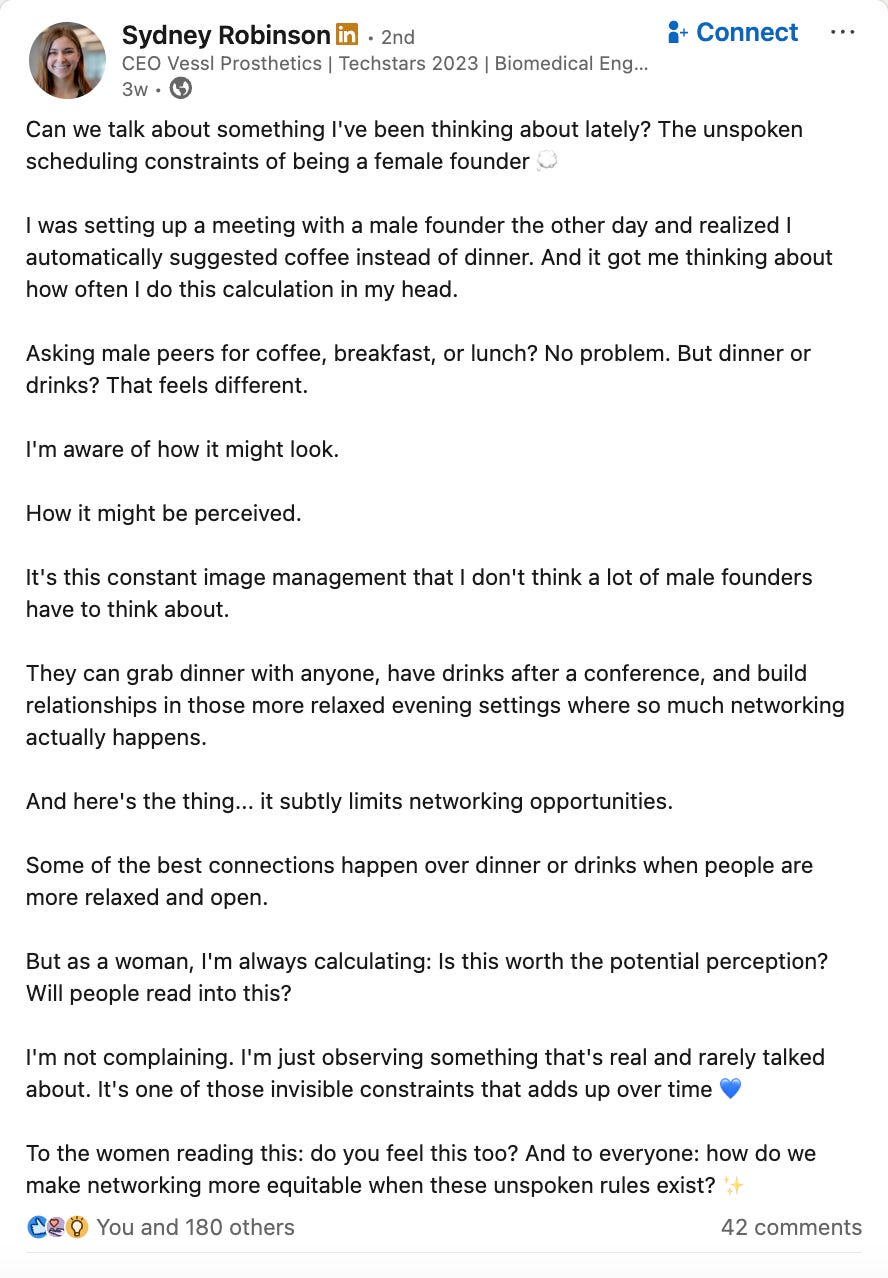
Sydney Robinson is talking about a very real problem here.
Personally, I’ve been less concerned about “how it looks” and more concerned about my time being wasted if I learn intentions are anything other than to evaluate an investment opportunity.
Because each of those meetings costs me something. An hour here. An evening there. The mental load of preparing, showing up, staying sharp. And then the added layer of recalibrating in real time when you realize the dynamic isn’t what you expected.
Do you redirect the conversation? Do you exit early? Do you stay polite and see it through?
All of that is energy that doesn’t go back into the business.
Not to mention that I likely paid a babysitter $100 for me to be there, or left my partner home alone another night with a 6 month old, him carrying the load of childcare and another debit made in our “relationship account” that I need to find energy to deposit a “credit” in later.
The comments on that LinkedIn post mentioned the term “invisible constraint”.
And honestly, that’s perfect language to use. Because it’s something I don’t see men thinking about, let alone spend any amount of energy on when they’re raising for their own companies.
Not because they don’t care, but because they don’t have to.
Just like walking alone at night, I’d imagine.
There’s no extra calculation. No background processing running. For them there’s just the meeting! Just the opportunity!
For women, it is rarely just that.
There is an additional filter applied to every interaction, an ongoing assessment that becomes so normalized it almost disappears into the background.
It’s taken me this long to even process these interactions and the invisible tax of it all in my own mind.
But it is still there, quietly shaping decisions about which opportunities to pursue, which rooms to enter, and how often you’re willing to put yourself in situations that may or may not be what they initially appear to be.
So, another drain of energy. And another waste of time, as every meeting with someone like that could have been time spent with someone worthwhile.
When we talk about women getting access to capital, we tend to focus on the visible barriers - the pitch opportunities, warm introductions or who gets into the room. But there’s a layer underneath that.
This isn’t something that shows up in funding reports or diversity statistics, but it does have a real impact on how the process unfolds.
If the primary advice for raising capital is to maximize the number of interactions, and the quality and intent of those interactions are uneven, then the playing field is not as level as it might seem even when we do get the opportunity to be in the right room.
None of this is to suggest that women should opt out of the process, or that meaningful connections aren’t being made every day. They are.
There are so many men I’ve interacted with during this process that felt safe, authentic, and whom I have ongoing friendships and mentorships with to this day.
But if we’re serious about understanding why access to capital remains unequal, it requires looking beyond the surface-level advice and acknowledging the less visible dynamics that shape how that advice plays out in practice.
I wonder if this is part of why we’ve seen founding teams with a mix of genders raising more capital than they used to. It’s a good news story that woman at least are on these founding teams! But solo female founders haven’t been receiving more capital than they used to. In fact, it’s been quite stagnant.
We need a more honest conversation about what networking actually entails, and who, exactly, is paying the hidden costs of playing that game.
I don’t have the answer at the moment. There are many things about being a woman in this world I don’t yet know how to navigate. Maybe someone smarter than me will figure it out a few generations from now.
What I do know is that society is missing out on billions of dollars of opportunity, better cash flow efficiencies, higher profitability and more money going back into communities from female founders being at the helm.
Honest conversations surely must be a good place to start.